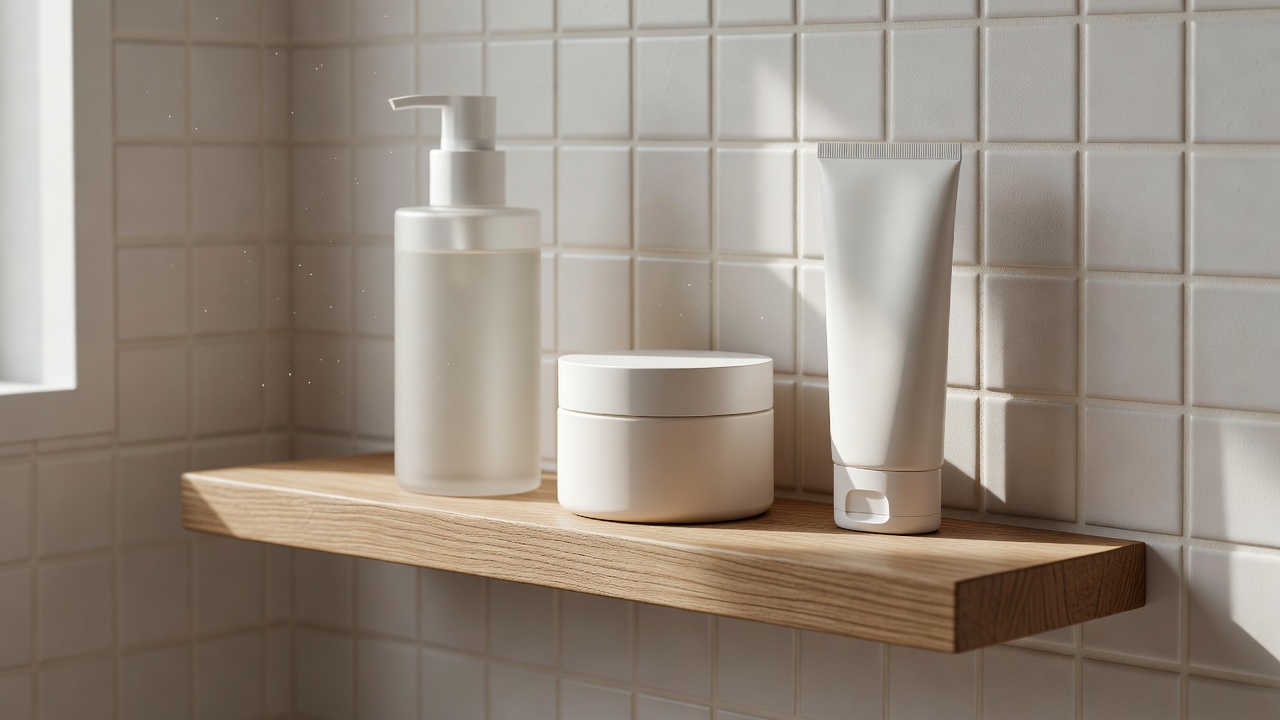
A five-minute morning routine that works for nearly everyone, and the parts you are allowed to skip.
Three bottles are enough to begin. The fourth is optional.
Mornings are busy, and that is exactly why a morning routine should be short. The goal is not to pamper; it is to get your skin ready for the day and shield it from the sun. If you build just this one habit and keep it for a few months, you are already ahead of most people with a cabinet full of half-used jars.
Step 1: Cleanse, gently
You washed your face last night, so in the morning you are mostly rinsing away sweat and whatever leftover night cream is sitting on the surface. Many people with dry or sensitive skin find that lukewarm water alone is enough. If your skin feels oily on waking, use a small amount of a mild, low-foam cleanser.
Avoid hot water and rough cloths. The skin's outer layer, the stratum corneum, works like a brick wall of cells held together by lipids. Stripping it every morning leaves you tight, red and more likely to react to everything else you apply.
Step 2: Treat, if you want to
This is the only truly optional step. A serum is a concentrated product aimed at one goal. Popular morning choices include vitamin C (an antioxidant often used for dullness and uneven tone) and niacinamide (often used for oil balance and redness). Both are generally well tolerated.
Our advice for your first month: skip it. Get comfortable with cleanser, moisturiser and sunscreen first. Once that feels automatic, add one serum and give it six to eight weeks before deciding whether it helps.
Add one new product at a time. If something goes wrong, you will know exactly what caused it.
Step 3: Moisturise
Moisturisers help skin hold on to water. Look at the first few ingredients: humectants such as glycerin and hyaluronic acid draw water in, emollients smooth the surface, and occlusives like dimethicone or shea butter slow evaporation. Oily skin often prefers a gel or light lotion; dry skin usually likes a cream.
Some sunscreens are moisturising enough to replace this step, especially in humid summers. If yours leaves you comfortable all day, that is fine. Fewer layers can mean fewer chances for pilling or irritation.
Step 4: Protect with sunscreen
If the routine had a headline, this would be it. Ultraviolet radiation drives most visible skin ageing and raises skin cancer risk. Dermatology bodies such as the American Academy of Dermatology recommend a broad-spectrum sunscreen of at least SPF 30 for daily use. "Broad-spectrum" means it protects against both UVA (linked to ageing, and able to pass through window glass) and UVB (the main cause of sunburn). In the UK and EU, look for a UVA logo in a circle or a high UVA star rating.
Use enough. A common guide is two finger-lengths for the face and neck. Most people apply far less than the amount used in SPF testing, which means real protection is lower than the label suggests. Apply it as the last step of skincare, before makeup, and reapply every two hours when you are outdoors for a long time, sweating or swimming.
A realistic timing plan
Cleanse or rinse: 30 seconds.
Serum, if using: 30 seconds, then a short pause.
Moisturiser: 30 seconds.
Sunscreen: one minute, including neck and ears.
That is under three minutes of actual work. Keep everything in the order you use it, at eye level, next to your toothbrush. Habit researchers often point out that linking a new behaviour to an existing one, such as brushing your teeth, makes it far easier to stick with.
What you can skip on hard mornings
Overslept? Rinse, apply sunscreen, go. Skin forgives an imperfect morning. What it does not love is a routine that changes every week. Pair this with our evening routine and check our skin type guide if a product feels wrong for you.
This guide is general information. If you have a skin condition, persistent irritation or a changing mole, please see a pharmacist, GP or dermatologist.